
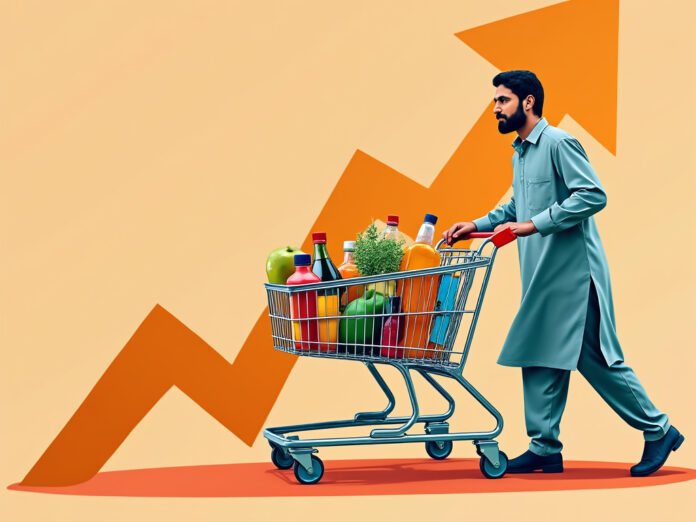
Federal Minister for Planning, Development and Special Initiatives Ahsan Iqbal presided over a session of the National Price Monitoring Committee (NPMC) to evaluate prevailing inflation dynamics and reinforce food security measures in anticipation of Ramadan.
The deliberations involved senior representatives from key institutions, including the Pakistan Bureau of Statistics (PBS), Ministry of National Food Security & Research, and provincial administrations, with deliberations centred on safeguarding price equilibrium and uninterrupted supply of essential commodities.
According to PBS data, headline inflation rose from 4.1% in December 2024 to 5.6% in December 2025, principally attributable to upward adjustments in gas tariffs, international gold valuations, and domestic prices of wheat, milk, and poultry. Conversely, select essentials such as potatoes, onions, and tea exhibited price moderation.
The Decision Support System on Inflation (DSSI) analysis reflected enhanced stability for core food items, with onions and potatoes registering lower levels year-on-year. Wheat flour prices, however, increased from Rs1,800 to Rs2,146 per 20kg bag over the preceding twelve months.
The meeting noted encouraging progress in wheat cultivation, with sowing targets fully achieved and expectations of a bumper harvest by February, thereby securing national wheat requirements. Notable price corrections were observed in sugar (declining from above Rs180/kg to approximately Rs150/kg) and chicken following earlier elevations.
Minister Iqbal directed the Ministry of National Food Security & Research to commission an in-depth assessment of cold chain logistics infrastructure to minimise post-harvest losses and market volatility. The ministry was further instructed to examine international benchmarks and propose incentive frameworks for poultry, dairy, and juice industries to foster value addition and export potential.
Addressing public health concerns linked to substandard ghee production involving adulterated oils, the minister called for rigorous enforcement of food safety regulations. He also sought comprehensive reports on agriculture-linked import substitution strategies and pathways toward greater national self-sufficiency in key crops to conserve foreign reserves.
The Ministry reported robust national stockpiles, with wheat reserves adequate for the ensuing four months and enhanced sugar availability from the ongoing crushing campaign. The minister mandated a targeted review of supply chains for gram, edible oils, dates, and pulses—commodities subject to heightened Ramadan demand—to forestall shortages and speculative pricing.
To maintain equilibrium during the holy month, provinces were instructed to collaborate closely with PBS on stock verification and initiate firm action against hoarding and profiteering practices. Minister Iqbal underscored the imperative of continuous inter-governmental, regulatory, and institutional coordination to safeguard consumer interests and uphold broader macroeconomic stability, reaffirming the government’s resolve to pursue evidence-based policymaking, proactive interventions, and enduring structural reforms for price moderation, food security, and societal welfare.
.jpg)
.jpg)

.jpg)
This website has been developed with good faith to create facilities for the people.Your ID Password and access to our website is for a specific period or temporary, it may be suspended at any time without telling any reason.Your ID Password or access does not create any your rights or liability onto owner of the website.
Office # 3-6, Ground Floor Idrees Chamber ,Talpur Road Karachi
info@taxhelplines.com.pk
+ 92 314-4062161
021-32462161
+ 92 305-2561915